
We are starting the blog tour for this incredible novel with a Q&A with author Robin Scott-Elliot. Featuring some photos that helped to bring this story to life.
The settings for your books are all different. The Tzar’s Curious Runaways in Russia at the time of Peter the Great, The Acrobats of Agra in India during the Indian Rebellion of 1857 and Hide and Seek in Paris and Scotland during World War Two. Sweet Skies has only one setting, Berlin, but at a time when it’s divided into four so it’s almost like four different cities and crossing from one to another can cost you your life. What inspired you to choose Berlin?
I’d always had an interest in Berlin since a childhood visit when the Wall was up and Checkpoint Charlie was one of the most famous places in the world. My mum had lived there as a girl not long after the war and she’d told me plenty of stories, some of which I’ve used as part of the book (eg Otto’s father coming back from a prison camp).
The city has a modern history of extremes. The backdrop to Sweet Skies is a city of ruins and rubble, dust and despair. Whereas the Berlin of the 1920s, one of the most liberal cities the world has seen, dazzled and displayed itself, Berlin of 1948 is a skeleton of a city. And today, obviously, it is again something else. All great cities, St Petersburg, Agra, London, Paris – to pick ones from my previous books – have great histories, but few have presented so many different faces to the world in a relatively short space of time as Berlin. It’s a great stage on which to set a story.
When I read, villains have a tendency to stay with me, particularly if they’ve got soul and feel real. I think you’ve created a wonderful villain in Zaitsev, the Russian commander. I was really convinced by the way he straddles empathy and brutality when he says to Otto that fathers need sons and at the same time threatens to kill him. What inspired you to create Zaitsev?
I did a 60-second interview recently where one of the questions was ‘Hero orvillain?’ Villain, every time. I’ve been a villain fan since reading Treasure Island – Long John Silver is the villain template. He’s bad, properly bad, a cold-blooded killer, but there’s another side to him. There are moments when he is genuinely kind to Jim.
Some of history’s most appalling ‘villains’ have those moments, glimpses of humanity. Like Peter the Great, who features in my first book, The Tsar’s Curious Runaways. And a fictional villain must have that too if they are to convince.
As a child of the Cold War, I’ve always been fascinated by our No1 nation of villains, the Russians. ‘Oh those Russians,’ as Boney M put it (singing about another great real-life villain in Rasputin)!
How do you live and survive under a brutal regime that lasted a lifetime? When the war ends Zaitsev goes on fighting for his survival, his place in the Soviet world.
Every European character in Sweet Skies has been damaged by war – the Americans less so – because there was no escaping it. Zaitsev has been hardened by war, brutalised, the price of life becoming cheaper than one of the watches he collects. But back home he still has a family – itself fractured by war – and a son. He’s missed his son growing up and in Otto he sees, just for a moment, what his son might have become. He’s clinging on to his humanity.
Nevertheless, any villain worth his ill-gotten salt must still be menacing, the reader must believe Zaitsev will pull the trigger when he takes aim – which then makes the moments of humanity so much more surprising. Another time, another place, Zaitsev would have shot Otto… wouldn’t he?
Which bits of Sweet Skies did you most enjoy writing and why?
I love writing the beginning. I tend to write the opening to my books before I do the detailed planning. I get the idea for a story and the opening scene quickly becomes part of that. So I write it straight away; then I feel the story is real, the characters alive and ready to be written. Get the opening right and the rest will fall into place. At least that’s the idea!
When you researched the Berlin airlift you found some wonderful contemporary images. Please could you share some with us and comment.
1948 falls in what I think was the golden age of photography. The technology had improved and the likes of Robert Capa and Lee Miller had made news photography into an art form.
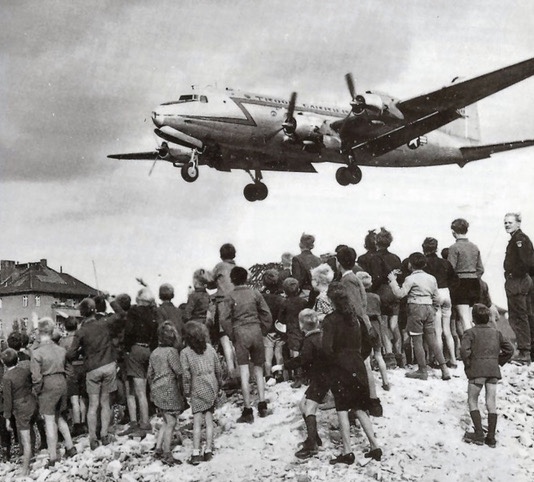
Here a Skymaster comes into land at Tempelhof airport during the airlift. You can stare at this for ages… the framing and cropping is so good it almost looks staged, the two girls in check coats, the boys with their arms in the air, pushing forward, the pile of rubble, the US serviceman glancing round, the only one aware of the photographer. This is what I’ve tried to capture with Otto and his friends when the chocolate drops begin.
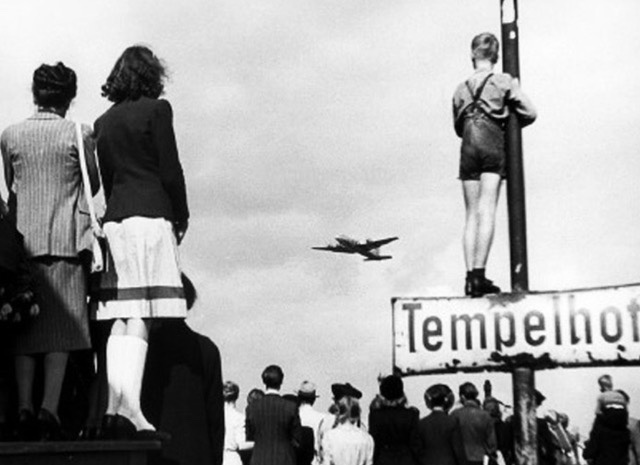
This one too is perfectly framed – the airport’s name, the boy in traditional shorts, the women looking as if they might even have dressed up for the occasion. All waiting patiently, and in the distance, the aeroplane coming to save them and their city.
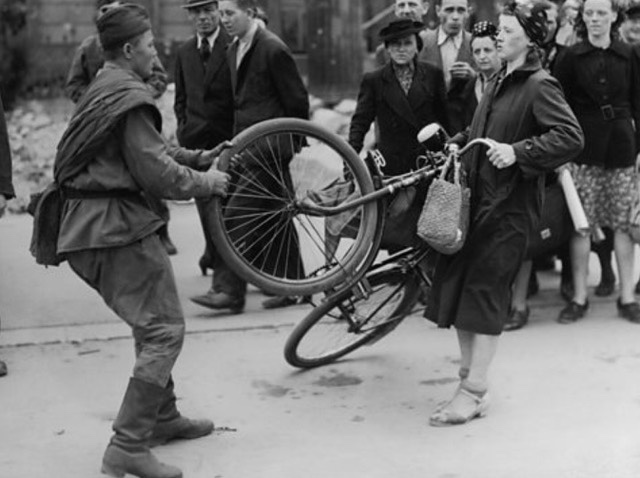
This picture was taken not long after the Soviet occupation began. Bicycles and watches were an obsession for many Russian soldiers, and they took what they wanted. Except here this young woman has decided the even-younger soldier is not going to get it. She is taking a huge risk. In the background the reaction of her fellow Berliners is remarkable – this is an everyday event, some walk on by, others watch, nobody seems prepared to get involved.
What are your three best tips for young writers?
There’s that old New York joke – how do you get to Carnegie Hall… practice, practice, practice. It’s not an inspiring tip, but it is a vital one. The more you write, the better you will get. It will pay off, I promise!
Find your own voice. Don’t try and be the next X, Y or Z – be the first you (and you will find your voice through practising!)
Enjoy your writing, enjoy creating your story, your characters. Unlike at school or college, there are no rules when it comes to writing your story. Do what you like, do what you enjoy – if you don’t enjoy your own writing then nobody else will.

 My Shelves Are Full