

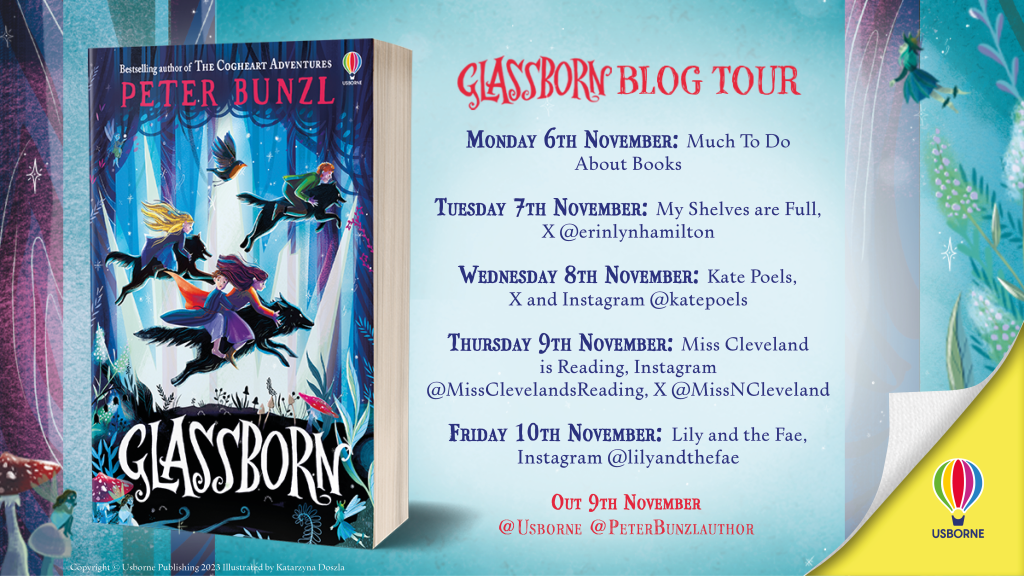
As part of the blog tour for this brilliant book, I am so pleased to share a Q&A with Peter Bunzl.
Tell us a bit about Magicborn and Glassborn and how they relate to each other.
Magicborn is set in 1726. It’s about two children with Fairy magic who get kidnapped by an evil sorcerer. To escape they must discover their connection to Fairyland and the Fairy Queen.
Glassborn is set 100 years later, in 1826, it is about four children who journey to Fairyland to fight the Fairy Queen and banish the curse she has put over their family.
The connection between the stories is the fairy magic and the recurring fairy characters, plus the similar secrets the children in each novel discover about how families are connected to Fairyland.
Brontë fans may find some familiarity within Glassborn. Can you share some of your inspirations for Glassborn?
Glassborn was inspired by two things: the childhood of the Brontës and the book The Lion the Witch and the Wardrobe. The original idea was something like: Angria meets Narnia. Or, in another form: what if the four Brontë children went to Fairyland like the Penvensies went to Narnia?
I researched the Brontë’s childhoods at the amazing museum in Haworth. I couldn’t use them exactly, because I wanted to change the story and make-up of the family, but lots of objects from their house and the Haworth parsonage itself inspired the world of my story.
When you begin a new book, do you have an end result in mind that you aim for or do you let the story lead you to its conclusion?
I am someone who likes to plan a bit so I know where the story is going. Often times I will have an idea of what I think the end should be quite early on. I will write a placeholder ending before I have finished the first draft, so I have something to aim towards.
The fairy Queen is a well known villain- what is it about her that we love the most as a villain do you think?
The Fairy Queen is an archetypal character. She appears in many folk songs, stories, plays etc. and has also appeared in fiction throughout the ages. One of my favourite stories of the Fairy Queen is the Scottish folk song The Ballad of Tam Lin, which was the inspiration behind Diana Wynne Jones’s YA novel Fire and Hemlock. I think what we love about the Fairy Queen as a villain is her mercurial nature. The chaos in her soul means she is unpredictable and doesn’t play by human rules. That’s a great quality for a villain in a children’s story, because children love the idea of both playing by the rules and bending and breaking the rules to win, which Acton and his siblings must do if they are to defeat the Fairy Queen.
Will there be more from Acton and his siblings?
I hope so, but at the moment I am starting a story about some different characters, so I will see where that leads me.

 My Shelves Are Full
Great Interview. I particularly liked finding out more about the Fairy Queen villain.
LikeLiked by 1 person